Points Based Grade Calculator
Use this points based grade calculator to add up points earned and points possible across one or several assignments to instantly see your overall percentage and letter grade — no weighting by category, just a straight points total.
Points-based grading simply sums everything earned over everything possible — it does not weight categories like homework or tests differently. If your class uses category weights instead of a straight points based grade calculator, try the Weighted Grade Calculator.
What Is a Points Based Grade Calculator?
A points based grade calculator adds up every point you've earned across your assignments and divides it by every point that was possible, with no separate weighting by category. This is the grading method many college courses use instead of a weighted percentage system — every quiz, homework set, and exam simply contributes its raw point value to one running total.
This differs from a weighted grade calculator, where categories like homework or exams are each assigned a percentage of the final grade regardless of how many raw points they're worth. In a points based grade calculator, a 50-point exam and a 5-point quiz just add directly into the same total — the exam naturally counts more because it's worth more points, not because of an assigned category weight. This is what makes a points based grade calculator simpler to use than a weighted one for courses that grade this way.
Grade Calculator Points: How to Turn Total Points Into a Percentage
Searching for a grade calculator points tool usually means one thing: you have a total of points earned and points possible, and you want a percentage. That is exactly what this points based grade calculator does. Enter your points earned and points possible, and the grade calculator points formula runs instantly: points earned divided by points possible, times 100. Use the Multiple Assignments tab to add every quiz, test, and essay into one running total.
Standard Grading Scale for Points-Based Grading
Once the points based grade calculator gives you a percentage, match it against your school's grading scale. Most U.S. schools use this baseline:
| Percentage | Letter Grade |
|---|---|
| 90–100% | A |
| 80–89% | B |
| 70–79% | C |
| 60–69% | D |
| Below 60% | F |
Points Based vs. Weighted Grading
Many college courses — and an increasing number of high school classes — use a points based grading system because it's simpler to set up and explain than a weighted one. Every assignment is worth a set number of points, and your grade is just total earned over total possible. According to MSU Denver's CTLD teaching resource on weighted grading, points-based grading remains the more common default system, with weighted grading used specifically when an instructor wants a category (like exams) to count more regardless of how many points it's worth. A points based grade calculator makes this simple because it only needs two numbers: points earned and points possible.
The tradeoff: in a points based system, a single large assignment can end up carrying more influence than intended just because it's worth more points. In a weighted system, an instructor sets that influence directly by assigning a fixed percentage to each category — a distinction worth knowing if you're comparing your grade calculation to a classmate whose class uses the other method. For general background on how percentage-based grading scales work more broadly, Wikipedia's overview of academic grading in the United States is a useful reference.
Example: Points Based Grade Calculation
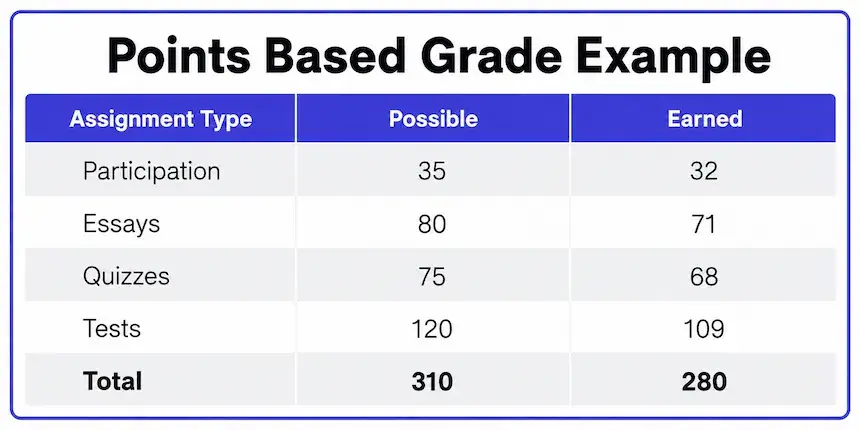
Say your course has a 35-point participation grade, two 40-point essays, five 15-point quizzes, and two 60-point tests. Add every point value together for your total possible, then add up everything you actually earned. Divide earned by possible and multiply by 100 for your percentage — exactly what the points based grade calculator above does automatically, whether you have one assignment or fifteen.
| Assignment Type | Points Possible | Points Earned |
|---|---|---|
| Participation | 35 | 32 |
| Essays (2 × 40) | 80 | 71 |
| Quizzes (5 × 15) | 75 | 68 |
| Tests (2 × 60) | 120 | 109 |
| Total | 310 | 280 |
In this example, the points based grade calculator would divide 280 by 310, giving 90.3% — an A on the standard scale. Notice how the tests and essays, worth more points each, naturally carry more influence on the final total than the smaller quizzes and participation grade.
When Should You Use a Points Based Grade Calculator?
A points based grade calculator is the right tool whenever your syllabus lists assignments by point value rather than by percentage weight — look for phrasing like "worth 50 points" or "out of 100 points" rather than "worth 20% of your grade." Many college courses, and a growing number of middle and high school classes using platforms like Canvas or Google Classroom, default to this points-based structure because it's straightforward to set up and easy for students to track running totals throughout the term.
If your syllabus instead lists categories with percentages that add up to 100% — for example, "Homework 20%, Quizzes 30%, Exams 50%" — you're in a weighted system, and the Weighted Grade Calculator will give you a more accurate result.
In short, if your syllabus lists points, use the points based grade calculator at the top of this page.
Frequently Asked Questions
Add up every point you earned across all your assignments, add up every point that was possible, then divide earned by possible and multiply by 100. The points based grade calculator above does this automatically for one total or multiple assignments.
42 divided by 50 is 0.84, or 84% — a B on the standard grading scale.
No — 40% falls well below the typical 60% passing threshold used at most U.S. schools and would be graded an F. Passing cutoffs can vary by school, so check your syllabus if it matters.
Points based grading sums raw points across everything with no separate category weighting. Weighted grading assigns each category (like exams or homework) a fixed percentage of the final grade, regardless of how many raw points it's worth.
Yes — since every point contributes equally to the total, a 100-point exam naturally has more impact on your grade than a 10-point homework assignment, simply because it's worth more points.
Yes — use the "Multiple Assignments" tab on the points based grade calculator above and add a row for every assignment, quiz, and test. It sums all points earned and possible across every row you add.
Simply leave that assignment's row out of the calculator, or remove it using the ✕ button, so it isn't included in your points earned or points possible totals.
60 out of 100 is 60%, which lands right at the D range on the standard scale — the minimum passing grade at most U.S. schools.
72 out of 80 points is 90%. Divide 72 by 80 to get 0.90, then multiply by 100. On the standard U.S. scale, 90% is an A, or an A- on a plus/minus scale. To check any other score, enter points earned and points possible into the points based grade calculator above.
The grade for 75 points depends on how many points were possible. Out of 100, it is 75%, a C. Out of 80, it is 93.75%, an A. Out of 90, it is 83.3%, a B. Divide your points earned by points possible, then multiply by 100, or use the points based grade calculator above.
To include extra credit in a points-based grade, add the bonus points to your points earned but not to points possible. For example, 95 earned plus 5 bonus points over 100 possible gives 100%. Some teachers cap extra credit, so check your syllabus, then enter the totals in the points based grade calculator.

Michael builds free, transparent calculators for teachers and students. Every tool on this site shows its formula so any result can be verified by hand — no black boxes, no sign-ups, no tricks.
Every grading scale and formula on this page is checked against standard US grading conventions before publishing, and updated whenever a tool's logic changes.