Test Grade Calculator
Enter your test results to instantly see your percentage and letter grade — grade by questions missed or by points lost, whichever matches how your test was scored.
| Missed / Lost | Percentage | Letter Grade |
|---|
Grading scales vary by teacher and school — this test grade calculator uses the standard 90/80/70/60 scale by default; check your syllabus if a different scale applies.
What Is a Test Grade Calculator?
A test grade calculator turns your raw score — the number of questions you got right or wrong, or the points you earned — into a percentage and a letter grade instantly. It saves the manual math of dividing correct answers by total questions and then matching the result to a grading scale, which is especially useful for teachers grading a full stack of papers or students checking a score right after a test.
This grade test calculator works two ways: by counting questions missed, or by counting points lost, so it fits both multiple-choice tests scored by question and exams scored by point value.
Use this test grade calculator as an exam grade calculator too: enter the questions you missed or the points you lost, and the percentage appears right away.
Standard Test Grading Scale
Once your percentage is calculated, this test grade calculator matches it against the standard U.S. grading scale below. According to Wikipedia's overview of U.S. academic grading, this five-letter scale is the most common baseline used across American schools, though exact cutoffs can shift by teacher or district.
| Percentage | Letter Grade |
|---|---|
| 90–100% | A |
| 80–89% | B |
| 70–79% | C |
| 60–69% | D |
| Below 60% | F |
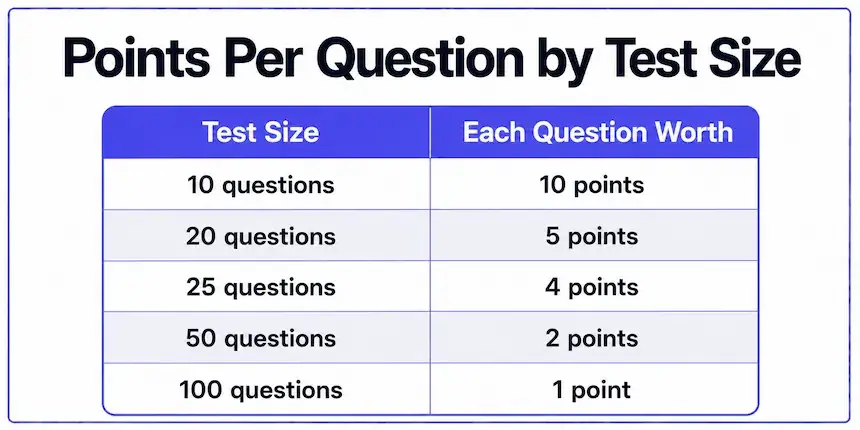
Points Per Question by Test Size
When every question on a test is worth the same amount, each one is worth 100 divided by the total number of questions. This quick reference shows the value of a single question for common test sizes, so you can see at a glance how much one missed question costs.
Once you know what each question is worth, enter your misses into the test grade calculator above to see the final percentage.
| Test Size | Each Question Is Worth |
|---|---|
| 10 questions | 10 points (10%) |
| 20 questions | 5 points (5%) |
| 25 questions | 4 points (4%) |
| 40 questions | 2.5 points (2.5%) |
| 50 questions | 2 points (2%) |
| 100 questions | 1 point (1%) |
For test sizes not listed here, or to see the exact percentage after missing a specific number of questions, use the "View Full Grading Chart" button on the calculator above — it builds a complete breakdown for any total you enter.
How to Calculate Your Test Grade
- Count your total questions or total points. This is the maximum possible score on the test.
- Count what you missed. Either the number of questions you got wrong, or the points you lost.
- Subtract missed from total, then divide by total. This gives you the fraction of the test you got right.
- Multiply by 100. That's your percentage score — enter it into the test grade calculator above, or do the math by hand using the formula in the section above.
According to Wichita State University's exam grading definitions, this percentage-based score is often referred to as the "percent score" and is distinct from a percentile, which instead compares a student's score to everyone else who took the same test.
To check your work, enter the same numbers into the test grade calculator and compare the result with your manual answer.
Grading a Test by Points
Not every test is scored by counting questions. Many exams assign different point values to different questions, so a test grade calculator working from points instead of question counts is often more accurate for these cases. The math is the same — points earned (or total minus points lost) divided by total points possible, multiplied by 100 — but it accounts for questions that are weighted differently instead of assuming every question is worth the same.
Use the "By Points" tab in the grade test calculator above if your test used a point system rather than a simple correct/incorrect count per question.
If your teacher scores by points, the test grade calculator gives the same percentage as the manual method, and works as an exam grade calculator for point-based exams.
Why a Single Test Score Isn't Your Whole Grade
A test grade calculator tells you how you did on one specific test, but most course grades combine several tests, quizzes, and assignments — often weighted differently. A strong or weak score on one test usually only shifts your overall course grade by a fraction, depending on how much that test is worth. If you want to see how a specific test score affects your overall class standing, a weighted or semester grade calculator is the better next step.
In short, a test grade calculator shows how one test went, and a weighted grade calculator shows how it affects your course grade.
Frequently Asked Questions
Divide the questions you got right by the total number of questions, then multiply by 100. For example, 40 questions with 7 missed gives (40 − 7) ÷ 40 × 100 = 82.5%. Use the test grade calculator above to skip the manual math.
Enter your total questions (or points) and what you missed into the calculator above to see this specific test's percentage and letter grade instantly. Keep in mind this is the grade for this test alone, not your overall course grade.
That depends on how much this test is weighted in your course. A single test is usually only one part of your grade alongside homework, quizzes, and other exams — use a weighted grade calculator to see the full impact.
This test grade calculator shows the result for a test you've already taken. To find a target score for an upcoming test based on your current course grade, a final grade calculator is the better tool.
Enter the total number of questions (or points) and how many were missed or lost. The test grade calculator instantly returns the percentage and letter grade, using the standard grading scale shown above.
Yes. A 90% is an A on the standard scale and is a strong test result at most U.S. schools. It means you answered nine out of ten questions correctly, or lost only 10% of the points. Check your syllabus, because some schools use a stricter scale.
Yes — switch to the "By Points" tab in the test grade calculator above and enter your total points possible and points lost instead of question counts.
Most U.S. schools set the passing threshold at 60% (a D), though some require 65% or 70%. For example, on a 50-question test you need at least 30 correct answers to reach 60%. Always confirm the exact passing score with your teacher or syllabus.

Michael builds free, transparent calculators for teachers and students. Every tool on this site shows its formula so any result can be verified by hand — no black boxes, no sign-ups, no tricks.
Every grading scale and formula on this page is checked against standard US grading conventions before publishing, and updated whenever a tool's logic changes.