Percentage to Letter Grade Calculator
Enter any percentage to instantly see your letter grade, or flip it around to find the percentage range for any letter grade — using the plus/minus scale or the simple A–F scale.
| Percentage | Letter Grade |
|---|
Grading scales vary by school and country — for the most accurate percentage to letter grade result, always confirm your instructor's exact syllabus scale if it matters for your GPA.
What Is a Percentage to Letter Grade Conversion?
A percentage to letter grade conversion takes a numeric score — like 87% on a test or 91% as a final course average — and maps it onto a letter (A, B, C, D, or F) using a fixed grading scale. Teachers, professors, and schools use letter grades because they're easier to interpret at a glance than a raw percentage, and because many transcripts and GPA systems are built around letters rather than numbers.
The tricky part is that there's no single universal scale. Most U.S. schools use some version of the 90/80/70/60 breakpoints below, but the exact cutoffs — and whether plus/minus grades like B+ or C- are used — can shift from school to school, and even from professor to professor within the same school.
Standard Grading Scale Chart
This is the most widely used percentage to letter grade scale in U.S. schools and colleges — also described in detail on Wikipedia's overview of academic grading in the United States. Use the calculator above for an instant conversion, or reference the percentage to letter grade table below directly.
| Percentage Range | Letter Grade | General Meaning |
|---|---|---|
| 90–100% | A | Excellent |
| 80–89% | B | Good / Above Average |
| 70–79% | C | Average / Satisfactory |
| 60–69% | D | Below Average / Passing |
| Below 60% | F | Failing |
How to Convert Percentage to Letter Grade
- Find your exact percentage. If you only know your points earned out of points possible, divide earned points by total points and multiply by 100.
- Check which scale your school uses. Most syllabi list the grading scale directly — look for whether it includes plus/minus grades (A-, B+, etc.) or just straight letters.
- Match your percentage to the correct range. Use the chart above for the standard scale, or the plus/minus table below if your school uses one.
- Decide how decimals are rounded. An 89.5% might round up to a B+/A- boundary at some schools and stay a B at others — this is set by the instructor, not a universal rule.
If you're not sure which scale applies, the safest approach is to check your course syllabus first — it almost always states the exact grading scale being used for that specific class.
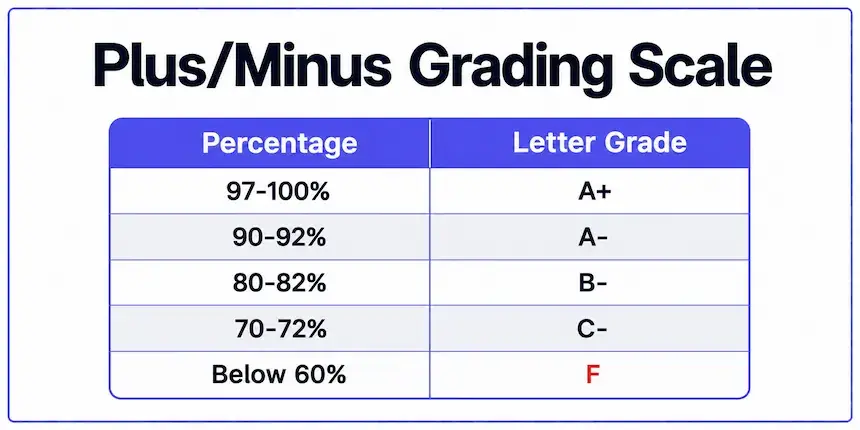
Plus/Minus Grading Scale
Many high schools and most colleges use an expanded percentage to letter grade scale that adds a plus or minus to each letter, giving a more precise read on where a score falls within its letter range. University of Illinois's Office of the Registrar is one example of a school publishing its exact plus/minus breakdown for reference.
| Percentage Range | Letter Grade |
|---|---|
| 97–100% | A+ |
| 93–96% | A |
| 90–92% | A- |
| 87–89% | B+ |
| 83–86% | B |
| 80–82% | B- |
| 77–79% | C+ |
| 73–76% | C |
| 70–72% | C- |
| 67–69% | D+ |
| 63–66% | D |
| 60–62% | D- |
| Below 60% | F |
Common Scores to Letter Grade (60–100)
Use this percentage to letter grade chart to check the most searched scores quickly. The plus/minus column follows the scale in the calculator above. Your school may use different cutoffs, so check your syllabus. For course-level grades, see the Midterm Grade Calculator and the Quarter Grade Calculator.
| Score | Standard (A–F) | Plus/minus |
|---|---|---|
| 60% | D | D- |
| 65% | D | D |
| 67% | D | D+ |
| 70% | C | C- |
| 73% | C | C |
| 74% | C | C |
| 75% | C | C |
| 76% | C | C |
| 77% | C | C+ |
| 78% | C | C+ |
| 80% | B | B- |
| 82% | B | B- |
| 83% | B | B |
| 84% | B | B |
| 85% | B | B |
| 87% | B | B+ |
| 90% | A | A- |
| 93% | A | A |
| 95% | A | A |
| 100% | A | A+ |
Why Grading Scales Vary by School and Country
The standard and plus/minus scales above cover most U.S. schools, but grading systems differ widely outside that context. UK schools using GCSE results report a 9-1 numeric scale rather than letters. Some Canadian provinces, including Ontario, use their own percentage bands tied to different letter or level descriptors. Universities sometimes set their own scale independent of the high school standard — for example, requiring a higher percentage for an A than a typical high school would.
Because of this, a percentage to letter grade calculator is most accurate when you confirm it against your own school's published scale rather than assuming the standard U.S. breakpoints apply everywhere.
7-Point vs 10-Point Grading Scale
Most schools use the 10-point scale (A starts at 90). Some use a 7-point scale. One common version is A 93–100, B 85–92, C 77–84, D 70–76, and F below 70. On that scale, an 84 is a C, and a 90 is a B. Because a percentage to letter grade conversion depends on the scale, check which one your school uses. If you need your own cutoffs, try the Grading Scale Calculator. To see how a score affects your whole course, use the Class Grade Calculator.
| Letter Grade | 10-Point Scale | 7-Point Scale |
|---|---|---|
| A | 90–100 | 93–100 |
| B | 80–89 | 85–92 |
| C | 70–79 | 77–84 |
| D | 60–69 | 70–76 |
| F | Below 60 | Below 70 |
Once you've got your percentage to letter grade result, these related calculators can help with the rest of your grade math:
Frequently Asked Questions
Compare your percentage against your school's grading scale — most commonly 90–100% = A, 80–89% = B, 70–79% = C, 60–69% = D, and below 60% = F. Use the calculator above to check instantly against the standard or plus/minus scale.
It's the process of translating a numeric score, like 87%, into a letter grade, like B+, based on a fixed set of percentage ranges assigned to each letter.
Find your percentage to letter grade range on your school's scale — if your points are given as a fraction rather than a percentage, divide points earned by points possible and multiply by 100 first.
On the standard scale, 95% is an A (93–96%). On a plus/minus scale, 95% still falls in the A range (93–96%), not A+, since A+ typically starts at 97%.
On the standard scale, 90% is an A (90–100% range). On a plus/minus scale, 90% is typically an A- rather than a B+ — B+ usually covers 87–89%.
On the standard scale, D covers 60–69%. On a plus/minus scale, it splits further into D+ (67–69%), D (63–66%), and D- (60–62%).
Under the standard U.S. scale, no — 50% falls below the typical 60% passing threshold and is graded an F. Some schools set a lower passing cutoff, so it's worth confirming against your own syllabus.
Neither — 80% is a B on the standard scale, or a B- on a plus/minus scale. A grades generally start at 90%.
70% is a C on the standard scale — a passing, average score, but not a strong one. Whether it counts as "good" depends on the difficulty of the course and your school's expectations.
73% is a C on the standard scale. On a plus/minus scale, it falls in the C range as well (73–76%), just above the C- cutoff.
A 77 is a C on the standard scale and a C+ on the plus/minus scale (77–79). On a 7-point scale it is also a C (77–84). Confirm with your syllabus.
An 84 is a B on the 10-point scale and a C on the 7-point scale (77–84).
A 60 is a D on the standard scale and a D- on plus/minus. On a 7-point scale it is an F, since a D starts at 70.
A 7-point scale gives each letter a 7-point band, such as A 93–100 and B 85–92, instead of 10 points. Use the scale in your syllabus.

Michael builds free, transparent calculators for teachers and students. Every tool on this site shows its formula so any result can be verified by hand — no black boxes, no sign-ups, no tricks.
Every grading scale and formula on this page is checked against standard US grading conventions before publishing, and updated whenever a tool's logic changes.