Grading Scale Calculator
Not every school uses the same 10-point A/B/C/D/F breakdown — this grading scale calculator lets you pick a common scale width or set your own to see exactly where each letter grade falls.
| Percentage Range | Letter Grade |
|---|
This grading scale calculator uses the width you set to build A/B/C/D/F cutoffs — smaller numbers mean a stricter scale, larger numbers mean a more lenient one. Check your syllabus for your school's exact width before trusting the grading scale calculator result for a real grade.
What Is a Grading Scale Calculator?
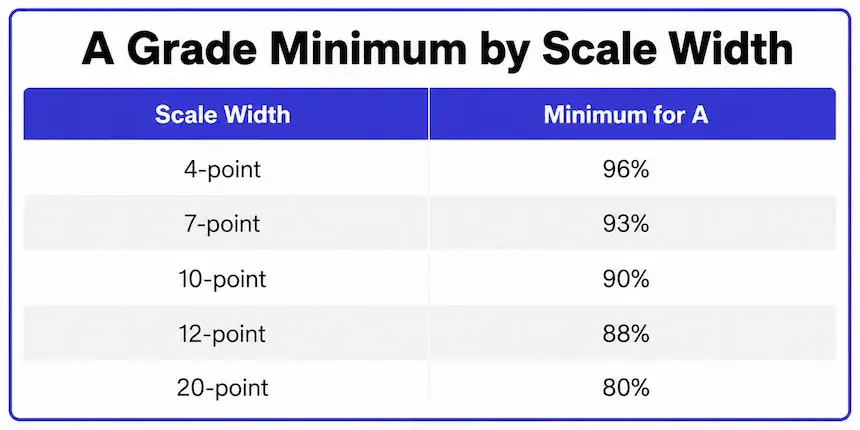
A grading scale calculator builds the percentage cutoffs for each letter grade based on how many points wide each letter is allowed to be. The familiar 90/80/70/60 breakdown most U.S. students grow up with is actually a "10-point" grading scale — each letter spans exactly 10 percentage points. Not every school uses that width, though. Some use a stricter 7-point scale, where the top grade requires a higher percentage. Others use a wider 12-point scale that's more forgiving. Whichever width applies to you, a grading scale calculator removes the guesswork of doing this math by hand.
This grading scale calculator lets you set any width from 4 to 20 points and instantly builds the full A/B/C/D/F chart for that scale, then tells you which letter your own percentage falls into if you enter one. Think of it as a grading scale calculator built specifically for schools that don't follow the standard 90/80/70/60 breakdown.
Common Grading Scale Calculator Widths
Here's how the three most commonly searched grading scale calculator widths compare:
| Scale Width | A Range | Description |
|---|---|---|
| 7-point | 93–100% | Strict — used by some universities and AP-style courses |
| 10-point | 90–100% | Standard — the most common U.S. scale |
| 12-point | 88–100% | Lenient — wider bands, easier to reach each letter |
Studying abroad? See how scales differ in our Grading Systems by Country guide.
Example: Setting a Goal Grade
Say your current course grade is 82%, you have 20% of your grade left (the final exam), and you want to finish with a 90% overall. This course grade calculator solves for the score you need on that remaining 20%.
| Current Grade | Remaining Weight | Target | Score Needed |
|---|---|---|---|
| 82% | 20% | 90% (A) | 122.0% (Not possible) |
| 82% | 20% | 85% (B) | 97.0% |
| 88% | 20% | 90% (A) | 98.0% |
| 92% | 20% | 90% (A) | Already secured |
The course grade calculator flags both extremes clearly: when a target is mathematically out of reach, and when it's already locked in regardless of what happens on the remaining work — so you always know exactly where you stand before the final grade posts. Running a few different scenarios through the course grade calculator before the term ends is one of the easiest ways to avoid an unpleasant surprise.
Typical Course Grade Calculator Category Weights
Not sure what weight to enter into a course grade calculator for each category? These are common patterns across different course types — always confirm against your own syllabus first.
| Course Type | Typical Weighting |
|---|---|
| High school course | Homework 15% · Quizzes 20% · Midterm 25% · Final 40% |
| College lecture course | Homework 10% · Midterms 40% · Final Exam 30% · Participation 20% |
| College seminar course | Papers 40% · Participation 30% · Final Project 30% |
These figures are common starting points, not fixed rules — every instructor sets their own breakdown, so treat this table as a rough guide rather than something to enter into a course grade calculator without checking first. If your syllabus lists a category this table doesn't cover, such as lab work or peer reviews, add it as its own row with whatever weight your instructor assigned — the course grade calculator handles any number of categories, so there's no need to force your syllabus into one of the three patterns above if it genuinely doesn't match.
Course Grade Calculator vs. Every Other Tool on This Site
This course grade calculator is the most general, cumulative version of grade calculation on the site — the whole course, any target grade, not scoped to a single test, quiz, marking period, or pass/fail threshold. Here's how it compares to the more specific tools:
| Tool | Scope |
|---|---|
| Course Grade Calculator | Entire course, any target grade |
| Class Grade Calculator | Entire course, pass/fail focused |
| Quarter Grade Calculator | One marking period |
| Midterm Grade Calculator | Midterm-plus-final structure specifically |
| Semester Grade Calculator | Quarters plus midterm plus final combined |
For background on how the weighted category grading behind any course grade calculator actually works, MSU Denver's CTLD resource on weighted grading breaks down the underlying math, and Wikipedia's overview of U.S. academic grading covers how these percentages typically map to letter grades.
Frequently Asked Questions
It means each letter grade spans 10 percentage points — A is 90-100%, B is 80-89%, and so on. This is the most common U.S. grading scale, and it's what most people mean by the "standard" scale.
A 7-point scale is stricter — it requires a higher percentage to earn each letter grade. Some universities and specific departments use it to set a higher bar for top grades, particularly in rigorous courses.
Check your syllabus — most instructors list the exact grading scale, including the point spread per letter, directly in the grading policy section. If it's not listed, ask your instructor or academic advisor directly.
This tool builds the five basic letter grades (A, B, C, D, F) for any scale width. If your school uses a plus/minus system on the standard 10-point scale specifically, the Percentage to Letter Grade calculator has a dedicated plus/minus mode built in.
This grading scale calculator supports widths from 4 to 20 points per letter. Widths outside that range are rare in real classroom use, but the underlying formula works the same way for any width if you need to calculate it by hand.
Not necessarily the class itself, but it does mean it's easier to reach a given letter grade — a 12-point scale needs only 88% for an A, while a 7-point scale needs 93%. The difficulty of the actual coursework is separate from how wide the grading bands are.

Michael builds free, transparent calculators for teachers and students. Every tool on this site shows its formula so any result can be verified by hand — no black boxes, no sign-ups, no tricks.
Every grading scale and formula on this page is checked against standard US grading conventions before publishing, and updated whenever a tool's logic changes.