Grade Curve Calculator
Curve a test score using the square root method, scale it linearly to the class high score, or shift it toward a target class average — three common curving methods in one tool.
Different teachers use different curving methods — check which one your instructor actually uses before relying on a grade curve calculator result for a real grade.
What Is a Grade Curve Calculator?
A grade curve calculator adjusts test scores upward when an exam turns out harder than intended, so the class result better reflects what students actually know rather than how difficult the test was. Curving doesn't mean lowering standards — it corrects for a miscalibrated test, and different teachers use different methods depending on the situation.
This grade curve calculator covers three of the most common curving methods: square root (gives the biggest lift to lower scores), linear scale (adds the same number of points to everyone so the top score becomes 100%), and curve to average (shifts every score by a fixed amount to move the class average to a target number).
Standard Grading Scale for Curved Grades
Once your curved percentage is calculated, match it against your school's grading scale. Most U.S. schools use this baseline:
| Percentage | Letter Grade |
|---|---|
| 90–100% | A |
| 80–89% | B |
| 70–79% | C |
| 60–69% | D |
| Below 60% | F |
How Each Curving Method Works
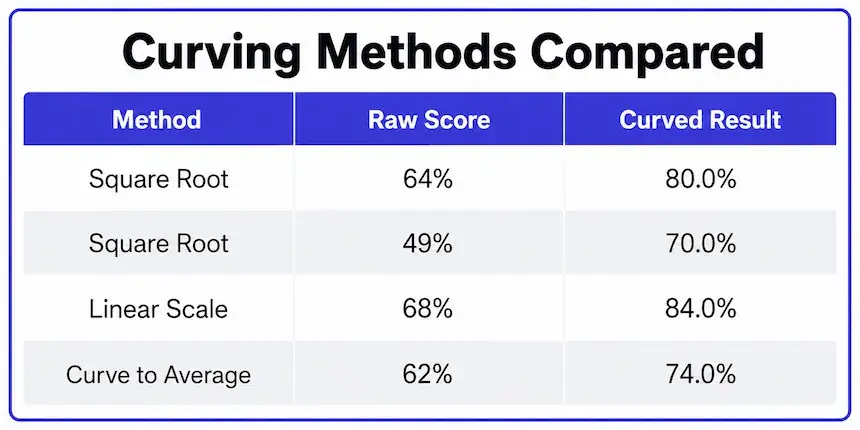
The grade curve calculator above handles the math for whichever method your instructor uses. Here's what each one actually does to a raw score:
| Method | Raw Score | Curved Result |
|---|---|---|
| Square Root | 64% | 80.0% |
| Square Root | 49% | 70.0% |
| Linear Scale (high score 84%) | 68% | 84.0% |
| Curve to Average (mean 68% → target 80%) | 62% | 74.0% |
Notice the square root method benefits lower scores the most — a 49% jumps all the way to 70%, while a score already near 100% barely moves. The linear and curve-to-average methods, by contrast, shift every score by the same fixed amount, so the ranking between students stays exactly the same.
Which Curving Method Should You Use?
The right tab to use in the grade curve calculator above depends on what you're trying to fix. The grade curve calculator does the math either way — you just need to pick the right tab. If the whole class struggled and you want to give the biggest boost to the students who scored lowest, the square root method is the standard choice. If you just want the class's top performer to land at 100% while keeping everyone's relative standing the same, use the linear scale. If you have a specific target average in mind — say, shifting a disappointing 68% class mean up to a more typical 80% — the curve-to-average tab of the grade curve calculator applies that exact shift to every score.
| Situation | Best Method |
|---|---|
| Whole class scored low, want to help weakest scores most | Square Root |
| Want the top score to become exactly 100% | Linear Scale |
| Have a specific target class average in mind | Curve to Average |
Why Teachers Curve Grades
According to CollegeVine's explanation of how teachers curve grades, a curve is usually applied when a test's average score comes in much lower than expected — signaling the exam itself was likely too difficult or poorly calibrated, not that the entire class failed to learn the material. A grade curve calculator standardizes that adjustment so every student is corrected consistently, rather than the teacher eyeballing individual point bumps.
It's worth noting that not every class uses a curve at all, and the exact method varies by instructor. If you're unsure whether your class curves grades, or which method applies, check your syllabus or ask directly — the Wikipedia overview of U.S. academic grading covers curving as one of several methods schools use alongside standard fixed-scale grading.
Frequently Asked Questions
It depends on the method. The square root method takes the square root of your raw score and multiplies by 10. The linear method adds the same number of points to every score so the class high becomes 100%. This grade curve calculator handles both, plus a third option — enter your numbers above for whichever method your instructor uses.
Using the square root method, a raw 75% curves to √75 × 10 ≈ 86.6%. The result depends entirely on which curving method is used, so check with your instructor which one applies.
With the methods in this grade curve calculator — square root, linear scale, and curve-to-average — scores only move up or stay unchanged, never down. Some rarer curving methods can lower high scores to fit a strict bell curve distribution, but that's uncommon in general classroom grading.
That depends on your instructor's rounding policy, not the curve itself — some round 89.5 up to 90 (an A), others truncate it and keep it as an 89 (a B+). Check your syllabus for the specific rounding rule if a grade is right on the boundary.
27 out of 40 is 67.5%, a D on the standard scale — technically passing at most U.S. schools, where 60% is the typical minimum, but on the low end.
The square root method gives a bigger boost to lower scores and a smaller boost to higher ones, which narrows the gap between students. A linear curve adds the same fixed number of points to everyone, so every student's relative ranking stays exactly the same.
A curve corrects for a test that turned out harder than intended after the fact, without the teacher needing to rewrite or re-grade the exam. It's a standardized fix applied consistently to every student's score.

Michael builds free, transparent calculators for teachers and students. Every tool on this site shows its formula so any result can be verified by hand — no black boxes, no sign-ups, no tricks.
Every grading scale and formula on this page is checked against standard US grading conventions before publishing, and updated whenever a tool's logic changes.